
Organic vs Paid for Contractors: Where Should You Invest First?
Contractors rarely lose because they "picked the wrong marketing company." They lose because they misunderstand what each channel is structurally capable of doing, and they allocate money as if all channels capture the same demand, with the same lead quality, at the same time horizon.
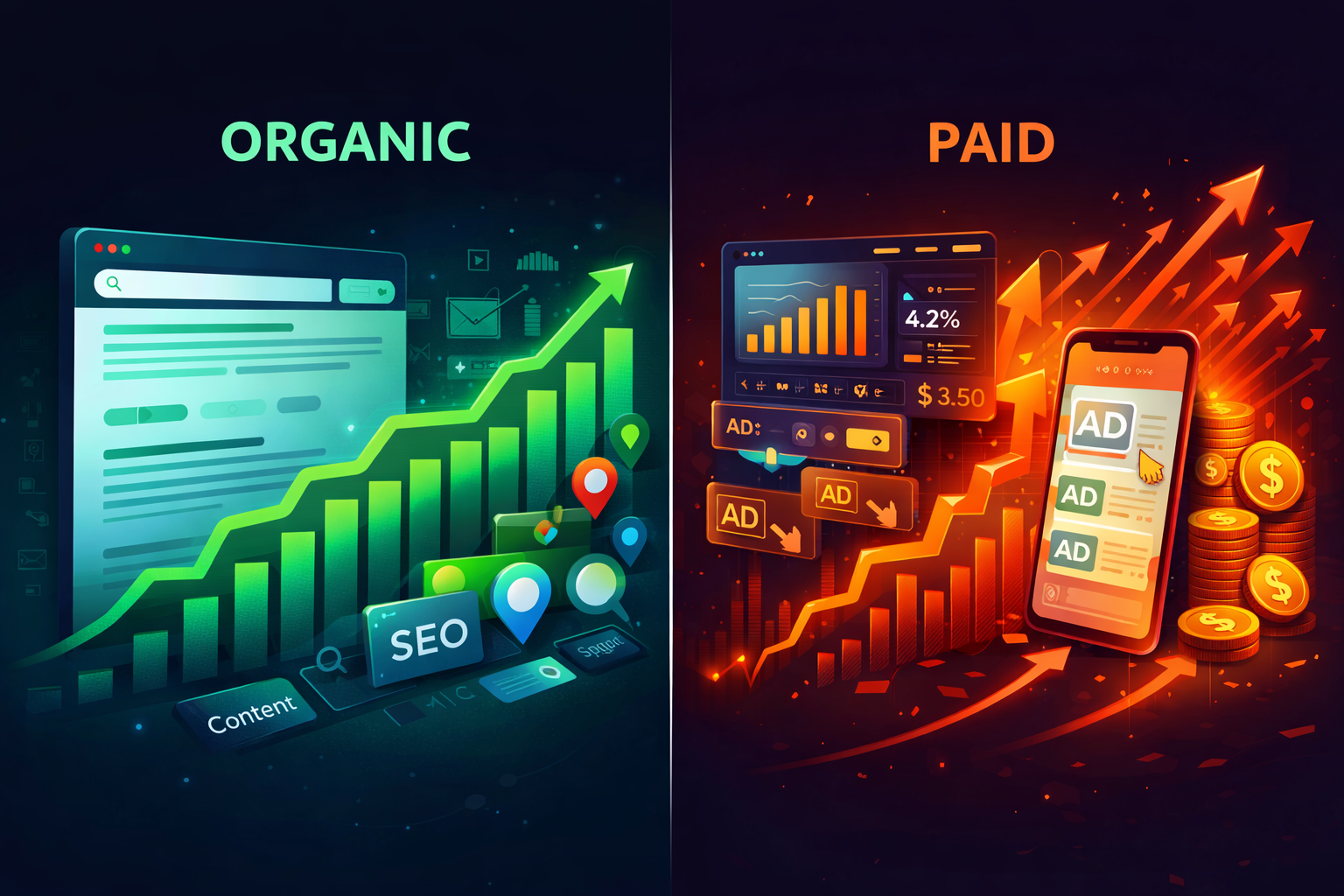
Paid media doesn't "create demand." It intercepts existing demand at a cost. Organic doesn't "generate leads." It builds durable capture surfaces that intercept demand over time with increasing efficiency.
When you treat paid and organic as interchangeable, you get: short-term spikes, inconsistent lead quality, unstable cost per lead, dependence on platforms, and confusion about what's working.


Quick Answer: The Contractor Marketing Allocation Diagnostic
If your business needs calls this week, paid capture is necessary. If your business needs calls every month without panic, organic capture is required. If your lead quality is low, it is usually not "a platform problem" — it's an intent + filtering + conversion architecture problem.
The correct strategy is almost never "paid vs organic." It's: paid for immediacy + organic to remove dependence, with sequencing that matches your trade and service mix.
What Home Service Demand Actually Is
In the home services industry, the majority of your revenue is not created by marketing. It is created by pre-existing homeowner problems: AC failures, clogged drains, roof leaks, electrical outages, water heater replacements, and remodel decisions.
Marketing is the mechanism that decides who captures that demand.
Paid capture is a toll road to demand.
Organic capture is building a permanent on-ramp to demand.
Both work. But they produce different lead types because they intercept different decision states.
Level 1 — Immediate Emergency Capture (Delegation Now)
Homeowner in "I need this fixed now" mode.
- Channels: Google Business Profile (Maps / click-to-call), Local Service Ads (Google Guaranteed), Google Ads (call-focused, emergency intent)
- Mechanism: urgency compresses evaluation; trust signals matter more than price pages
Level 2 — High-Intent Service Capture (Hiring Soon)
- Channels: service pages ranking organically, ads targeting specific services, review-driven map listings, comparison searches ("best electrician near me")
- Mechanism: homeowner compares 2–4 options; proof density determines who gets the call
Level 3 — Consideration and Price Anchoring
- Channels: SEO content (pricing pages, guides), strong service pages that answer objections, YouTube and local references
- Mechanism: homeowner is not ready to call immediately; earn trust and guide toward call pathway
Level 4 — Attention Capture (Awareness)
- Channels: Facebook mostly; creates familiarity but rarely converts urgent service calls
- Mechanism: treating Level 4 as a replacement for Level 1/2 burns budget and misaligns emergency demand
- Facebook can work for remodel or elective services, but structurally mismatched for emergency calls
The Demand Capture Ladder Model
Understanding how homeowners move from urgency to awareness.
Each level represents a different acquisition strategy.
Level 1 — Immediate Emergency Capture
This is the homeowner in "I need this fixed now" mode. Channels: Google Business Profile (Maps / click-to-call), Local Service Ads (Google Guaranteed), Google Ads (call-focused, emergency intent).
Mechanism: the homeowner is in pain, urgency compresses evaluation, and trust signals matter more than price pages.
Level 2 — High-Intent Service Capture
Channels: service pages ranking organically, ads targeting specific services, review-driven map listings, comparison searches ("best electrician near me").
Mechanism: the homeowner is willing to compare 2 to 4 options, and proof density determines who gets the call.
Level 3 — Consideration & Pricing
Channels: SEO content (pricing pages, guides), strong service pages that answer objections, YouTube and local references.
Mechanism: the homeowner is not ready to call immediately. Your job is to earn trust and keep them moving toward the call pathway.
Level 4 — Attention Capture
This is where Facebook sits for most contractors. Attention capture creates familiarity, but does not usually convert urgent service calls immediately (with exceptions in remodel and elective services).
Contractors who treat Level 4 as a replacement for Level 1/2 often burn money and complain that "Facebook doesn't work." Facebook can work — but it is structurally mismatched for emergency demand.
Local Service Ads vs Google Ads vs Organic SEO
LSAs (Google Guaranteed): what it really is
LSAs are a lead auction with trust weighting, where Google controls how you appear, when you appear, which jobs show, and how lead types are categorized.
Your performance is strongly influenced by review count and rating, response rate and speed, dispute behavior, budget willingness, service categories configured, and geography and proximity reality.
Cause-and-effect chain: If you are slow to answer, Google marks you less responsive, you appear less, you get fewer leads, you raise budget, Google gives you more — often lower quality. That trap is the LSA dependency pattern.
LSA Verifications and Reinstatements: We can offer LSA verifications and reinstatements for a fee, similar to how we handle GMB reverifications and suspensions. We do not currently support internal LSA campaign management, but do have a partnership with tried-and-true Google Ads partners.
Google Ads: what actually determines profitability
Ads are a system that weights intent specificity, relevance, landing page alignment, Quality Score dynamics, conversion rate, and competition density.
Cause-and-effect chain: Broad keywords, mixed intent, poor conversion, higher CPC, you raise bids, CPC rises, lead quality drops, you think Ads are "bad" — but the structural issue is intent mismatch. Google Ads is a precision tool. It punishes sloppy intent.
The majority of "bad leads" from Google Ads come from one of three structural errors:
- Keywords that are too broad
- Geography that is too wide
- Landing pages that route the visitor into friction instead of calling
Ads magnify your conversion architecture. They don't replace it.
Organic SEO: what it is (in contractor economics)
For contractors, organic SEO is primarily: Maps / GBP reinforcement, service-page dominance for revenue services, trust-building pages (pricing, guarantees, FAQs), and localized proof pages that match where you actually serve.
Organic growth is slow because Google requires evidence. But once you earn it, you reduce dependence.
Bad SEO takes forever. Structural SEO with revenue pages and proof systems shows directional improvement sooner — especially when paired with consistent reviews.
The Contractor Lead Quality Diagnostic Model
A lead is low quality when the homeowner isn't a fit, isn't ready, is price-shopping only, is outside your service scope, or is not in your geographic reality. Most contractors blame the platform. The platform is rarely the root cause.
Lead quality is controlled by four filters:
Filter 1 — Intent filter
Emergency intent produces higher booking rates than "cheap contractor" intent.
Filter 2 — Geography filter
If you target too far beyond your proximity advantage, you attract leads you can't serve profitably.
Filter 3 — Offer filter
If your ads say "same-day," but your scheduling can't support it, you generate frustration and low booking.
Filter 4 — Conversion filter
A weak landing page produces "confused" leads who call just to ask basic questions.
Hear From Our Clients
Trades We Focus On
We do great work for electricians, plumbers, garage door technicians, painters, roofers, movers, and appliance repair businesses.
For HVAC contractors specifically, we recommend having a paid ads budget in place from the start. The HVAC market is extremely competitive and organic-only approaches take longer to produce results.
We do not currently support locksmiths, power washers, or pressure washers.
Emergency Call Acquisition Strategy
Emergency calls are captured through speed, trust, and availability signals. The homeowner's decision criteria compresses: "Can you come now?" "Are you legit?" "Are you close?" "Will you rip me off?"
The Emergency Capture Stack — to win emergency calls predictably:
- GBP must be active, review-rich, and conversion-ready
- LSAs must be configured precisely and responded to fast
- Google Ads must target emergency-intent service keywords (not broad)
- Emergency landing pages must be call-dominant and trust-compressed
- Call handling must be operationally tight (answer rate, speed, booking)
Budget Allocation by Company Stage
Stage A: Early contractor / limited demand stability
Objective: stop the bleeding and capture urgent demand while building durable assets.
- Controlled paid capture for immediate calls
- Build GBP + reviews + service pages simultaneously
- Do not scale broad campaigns before your conversion system is strong
Stage B: Growth contractor (multi-tech, multi-service)
Objective: stabilize inbound, reduce paid dependence, improve lead quality.
- Expand service-page architecture
- Build multi-location structure where justified
- Maintain targeted paid for high-value services
- Strengthen call tracking and booking rates
Stage C: Established contractor (dominant in core area)
Objective: compound organic dominance and use paid strategically to expand or fill gaps.
- Organic fortress (maps + service page clusters + proof density)
- Paid used for seasonal gaps, new services, expansion zones
- Operational excellence becomes the limiting factor

-
Google Ads is worth it when you target high-intent service and emergency queries, and your landing pages are engineered for calls. It performs poorly when used to compensate for a weak conversion structure.
-
If you need calls immediately, start with controlled paid capture. But build SEO/GBP concurrently to reduce long-term dependency and stabilize lead flow.
-
LSAs are simpler and can produce strong emergency leads, but control is limited and lead quality can fluctuate. Google Ads offers more control and filtering but demands precision.
-
Low-quality leads typically come from broad intent targeting, unrealistic geography, poor negative keyword control, weak pre-qualification messaging, or landing page confusion.
-
Price shoppers usually come from low-intent keywords, generic ads, or pages that fail to establish differentiation and trust. Fix the intent filter and strengthen proof above the fold.
-
It can happen, but it's rarely the main cause of poor performance. Most wasted spend comes from broad keyword matching and weak filtering. Diagnose targeting first.
-
Facebook works best for elective or planned services (remodeling, upgrades, replacements) and brand reinforcement. It is usually not the primary driver of urgent emergency calls.
-
Emergency calls come from a stacked system: strong GBP + consistent reviews + LSA responsiveness + emergency-intent Ads + emergency landing pages + strong call handling.